









This branch (V5_NG) is rapidocr 5.0.0a2: a C++ PP-OCRv6 engine with a C ABI, a C++ API, and a Python package whose import name is still rapidocr. The 3.x line (latest tag v3.9.2) stays on main. Hosted demos linked from the badges above run that 3.x line.
📝 Introduction
RapidOCR is an open-source OCR library aimed at small models, offline deployment, and a short path from a PP-OCR weight file to a text box. Version 5 keeps the RapidOCR() call that 3.x applications already use, and runs PP-OCRv6 inside this repository instead of through ONNX Runtime.
The interpreter implements the operators used by the official PP-OCRv6 tiny, small, and medium ONNX detector and recognizer graphs: convolutions, GEMM, pooling, normalization, resize, shape ops, attention matmul, and the DB / CTC post-process. It is a PP-OCRv6 runtime, which means a general ONNX model still needs another engine.
If this project helps your work, a ⭐ Star helps it reach the next person.
✨ Features
- C++ PP-OCRv6 detector and recognizer. The library does not link ONNX Runtime, Paddle Inference, or OpenCV.
- One binary dispatches at runtime to AVX-512, AVX2+FMA, or AArch64 NEON.
PPOCR_FORCE_ISA=scalar|avx2|avx512|neonselects a legal path for measurements. An AVX2-only machine never executes the AVX-512 object file. - Optional Vulkan compute. Source builds embed SPIR-V when
third_party/Vulkan-HeadersandglslangValidatorare present (PPOCR_ENABLE_VULKANdefaults toON). The loader isdlopen/LoadLibraryoflibvulkan.so.1orvulkan-1.dll, so Vulkan is not aDT_NEEDEDdependency. Published wheels pass-DPPOCR_ENABLE_VULKAN=OFF. - C ABI (
include/ppocr/ppocr.h), C++ API (include/ppocr/ppocr.hpp), and the Python packagerapidocr. Python calls the C ABI with ctypes. - The Python call shape follows 3.x:
RapidOCR(params={"Section.key": value}), thenresult.txts,result.scores,result.boxes,result.elapse,to_json(),to_markdown(), andvis(). - Missing model files are downloaded from the ModelScope URLs in
default_models.yaml(the samev3.9.2file names as 3.x) intoGlobal.model_root_dir, and the SHA256 is checked.
🎥 Visualization

The animation is the RapidOCR 3.x web demo. On this branch the checked line sample is Hello RapidOCR 123 from python/tests/data/hello.png (960×240).

⚡ Performance
Models are PP-OCRv6 tiny ONNX. use_cls=False, so the angle classifier does not run.
| Sample | Size | What it contains |
|---|---|---|
| hello | 960×240 | one line, Hello RapidOCR 123 (python/tests/data/hello.png) |
| page | 1700×2200 | 45 lines. The page file is a local measurement image and is not committed in this repository. |
x86, Python wall clock. 4 vCPU Intel Xeon (family 6, model 207) with AVX2 and AVX-512F/DQ/BW/VL, constant 2.4 GHz, g++ 13.3, Python 3.12. The default pool is 4 threads (min(16, hardware_concurrency)). Forced AVX2 is PPOCR_FORCE_ISA=avx2 in the 5.0.0a1 process; ONNX Runtime 1.30.0 on this CPU stays on AVX-512. Each figure is the median of 8 calls after one warmup. Both packages use the shared Python defaults (config.yaml: short-side limit 736, mean/std 0.5, dilation on). A 960×240 line is enlarged until the short side reaches 736. rapidocr==3.9.2's own published default is PP-OCRv6 small with the classifier left on; that configuration was not timed.
| Package | hello | page |
|---|---|---|
| rapidocr 5.0.0a1, AVX-512 | 105.1 ms | 356.7 ms |
| rapidocr 5.0.0a1, AVX2 | 119.1 ms | 454.7 ms |
| rapidocr 3.9.2 (ORT 1.30.0) | 193.0 ms | 508.3 ms |
Against the 3.9.2 median, AVX-512 hello is 46% faster and the page is 30% faster. Forced AVX2 hello is 38% faster and the page is 11% faster. 3.9.2 was not remeasured for this table; 193.0 ms and 508.3 ms are the earlier back-to-back run. The page text is the same 45 strings on all three rows. Hello is Hello RapidOCR 123. Boxes versus the previous 5.0.0a1 binary have IoU 1.0 on both images.
ARM, C++. 20 cores: 10× Cortex-X925 (up to 3.9 GHz) and 10× Cortex-A725 (up to 2.8 GHz), g++ 13.3, NEON. ppocr_determinism with Backend::cpu_only, 16 threads, and the C++ defaults (long-side limit 960, ImageNet detector mean/std, dilation off). AArch64 recognition widths stay exact.
| ISA | Threads | hello | page |
|---|---|---|---|
| NEON | 16 | 32.7 ms | 222.9 ms |
Determinism passed on both images (1 line and 45 lines).
The older x86 C++ long-side-960 rows and the 1-thread rows are not listed. Repeating ppocr_determinism on this VM after the current kernels moved the AVX-512 page mean across about 203–229 ms from one pass to the next, so those means are not published. RapidOCR() in Python keeps the short-side preprocess in the table above. Set Det.limit_type, Det.limit_side_len, Det.mean, and Det.std when you want the C++ defaults. Earlier kernel notes live in docs/PERFORMANCE.md and are older than this section.
Vulkan page times from earlier adapter checks are not repeated here. Lavapipe on this VM is a software rasterizer, so its milliseconds are not GPU performance. Backend::gpu_only does not fall back to a CPU neural graph.
GPU on Apple silicon: Mac mini, Apple M4 (10 CPU cores 4P+6E, 10 GPU cores, 16 GB), macOS. Vulkan is MoltenVK through the Homebrew Vulkan loader; Metal is the native backend. ppocr_bench, PP-OCRv6 tiny det/rec, 3 warmup runs, median of 20, idle machine; both rounds of an alternating A/B run agreed within 2%. The page is a synthetic 1700×2200 image with 45 text lines, not the screenshot used for the x86 table.
| Image | CPU (NEON, PPOCR_BACKEND=cpu) |
Vulkan (MoltenVK) gpu_only |
Metal (PPOCR_BACKEND=metal) |
|---|---|---|---|
| hello (1 line) | 25.3 ms | 77.4 ms | 11.3 ms |
| page (45 lines) | 210 ms | 672 ms | 107.2 ms |
Metal is about 2× faster than NEON on hello and about 1.85× faster on the page, with text equal to CPU, box IoU 1.0, identical results across 4 threads, and no Metal API validation errors. It replaces the heaviest translated kernels with native MSL ones (simdgroup-matrix GEMMs for pointwise Conv, 3×3 Conv and the recognizer head), runs the DB postprocess on the CPU from the shared probability map, and reuses reclaimed arena slots. Recognition batches up to 8 crops of similar width (widest/narrowest ≤ 1.5) into one graph: each crop keeps its natural width, the padded columns are zeroed before every operator that mixes along the width, SE means divide by each crop's own area and CTC decodes only each crop's own steps, so the text matches the exact-width graphs. This is the default on Metal (PPOCR_DISABLE_GPU_REC_WIDTH_BATCH=1 turns it off; PPOCR_ENABLE_GPU_REC_WIDTH_BATCH=1 enables it on Vulkan, where it is slower on MoltenVK). Before these changes Metal measured 76 ms / 539 ms on the same machine, and 147.6 ms on the page before width batching. The remaining time is mostly GPU arithmetic in the recognizer's pointwise Conv GEMMs (about 1 TFLOPS on M4). PPOCR_METAL_KERNEL_PROFILE=1 with PPOCR_GPU_PROFILE=1 prints GPU time per kernel.
MoltenVK does not report per-dispatch timestamps, so PPOCR_GPU_PROFILE shows only host-side times there. Its text also equals CPU, with 0 validation errors and identical results across 4 threads.
🛠️ Installation
The PyPI name of this line is rapidocr_ng; the import name stays rapidocr, so code is the same as on main: pip install rapidocr_ng, then from rapidocr import RapidOCR. Both distributions install the same rapidocr package directory, so do not install rapidocr_ng and the official rapidocr in one environment; run pip uninstall rapidocr first.
5.0.0a2 is a pre-release. It is on PyPI only after a v5* tag is published (see Releasing). Then install it with:
pip uninstall rapidocr   # if the official package is installed
pip install --pre rapidocr_ng
from rapidocr import RapidOCR
From a checkout of this branch (CMake ≥ 3.20, a C++20 compiler, and the Python dependencies in pyproject.toml):
pip install .
That build follows pyproject.toml: shared libppocr, examples and tests off, Vulkan off. A local wheel is the same build packaged first:
pip wheel . -w dist
pip install dist/rapidocr_ng-*.whl
pip install ./python also works from a checkout. It points CMake at the parent tree and does not produce a self-contained sdist. The repository-root pip install . does.
CMake
git submodule update --init --recursive
cmake -S . -B build -DCMAKE_BUILD_TYPE=Release
cmake --build build -j
cmake --install build --prefix "$PWD/install"
PPOCR_BUILD_SHARED and PPOCR_BUILD_STATIC default to ON. Turn Vulkan off for a CPU-only library:
cmake -S . -B build -DCMAKE_BUILD_TYPE=Release -DPPOCR_ENABLE_VULKAN=OFF
Turn it on for a source package (headers and glslangValidator required):
CMAKE_ARGS="-DPPOCR_ENABLE_VULKAN=ON -DPPOCR_BUILD_STATIC=OFF" pip install .
CMake package
cmake_minimum_required(VERSION 3.20)
project(ocr_app C)
find_package(ppocr REQUIRED)
add_executable(ocr_app main.c)
target_link_libraries(ocr_app PRIVATE ppocr::ppocr)
The install prefix contains libppocr.so (SONAME libppocr.so.5), headers under include/ppocr/, and lib/cmake/ppocr/ppocrConfig.cmake. Link ppocr::static for the static library. At run time the dynamic loader has to see libppocr.so.5 (LD_LIBRARY_PATH or an rpath).
📋 Usage
Python
Paths below are the PP-OCRv6 tiny files. With the paths omitted, RapidOCR() downloads the configured default (PP-OCRv6 small, unless Det.model_type / Rec.model_type is tiny).
from rapidocr import RapidOCR

engine = RapidOCR(params={
    "Det.model_path": "PP-OCRv6_det_tiny.onnx",
    "Rec.model_path": "PP-OCRv6_rec_tiny.onnx",
    "Rec.rec_keys_path": "ppocrv6_tiny_dict.txt",
    "Global.use_cls": False,
})
result = engine("hello.png")
print(result.txts)
print(result.scores)
print(result.to_json())
result.vis("vis_result.jpg")
result.boxes is a float32 array of shape (N, 4, 2) in TL, TR, BR, BL order. File paths, URLs, bytes, and PIL images are read as RGB. A numpy ndarray is treated as BGR, matching 3.x OpenCV images, and converted to RGB before the native engine.
Automatic download of the tiny pair (files land in the package models/ directory when Global.model_root_dir is null):
from rapidocr import RapidOCR

engine = RapidOCR(params={
    "Det.model_type": "tiny",
    "Rec.model_type": "tiny",
    "Global.use_cls": False,
})
result = engine("hello.png")
print(result.txts)
Command line
python -m rapidocr hello.png \
  --det PP-OCRv6_det_tiny.onnx \
  --rec PP-OCRv6_rec_tiny.onnx \
  --dict ppocrv6_tiny_dict.txt \
  --model-type tiny
--model-type is tiny, small, or medium. The console script rapidocr calls the same main.
C++
#include "ppocr/ppocr.hpp"

#include <iostream>

int main(int argc, char** argv) {
  ppocr::Options options;
  options.backend = ppocr::Backend::cpu_only;
  ppocr::OCR ocr(argv[1], argv[2], argv[3], options);
  for (const ppocr::Result& result : ocr.Recognize(ppocr::LoadPPM(argv[4]))) {
    std::cout << result.text << '\t' << result.confidence << '\n';
  }
}
./ppocr_cpp_api_demo det.onnx rec.onnx dict.txt image.ppm
Images passed to the library are packed RGB, row-major, 8-bit. LoadPPM reads binary P6. JPEG and PNG decoding stays in the application (Pillow does it for Python).
C
#include "ppocr/ppocr.h"

#include <stdio.h>

int main(int argc, char** argv) {
  ppocr_options options;
  ppocr_options_init(&options);
  options.backend = PPOCR_BACKEND_CPU;

  ppocr_ocr* ocr = ppocr_create(argv[1], argv[2], argv[3], &options);
  ppocr_image_buffer loaded = {0};
  if (ppocr_load_ppm(argv[4], &loaded) != PPOCR_OK) return 1;

  ppocr_image image = {loaded.width, loaded.height, loaded.rgb};
  ppocr_result result = {0};
  if (ppocr_recognize(ocr, &image, &result) != PPOCR_OK) {
    fprintf(stderr, "%s\n", ppocr_last_error());
    return 1;
  }
  for (size_t i = 0; i < result.count; ++i) {
    printf("%s\t%.4f\n", result.items[i].text, result.items[i].confidence);
  }
  ppocr_result_free(&result);
  ppocr_image_free(&loaded);
  ppocr_destroy(ocr);
  return 0;
}
ppocr_recognize on one handle is serialized. Create one handle per thread when pages should run together. ppocr_options.struct_size is filled by ppocr_options_init so later fields can be appended.
Vulkan
Wheels are CPU-only. A Vulkan-enabled build selects the device in the same place 3.x puts use_cuda:
engine = RapidOCR(params={
    "Det.model_path": "PP-OCRv6_det_tiny.onnx",
    "Rec.model_path": "PP-OCRv6_rec_tiny.onnx",
    "Rec.rec_keys_path": "ppocrv6_tiny_dict.txt",
    "Global.use_cls": False,
    "EngineConfig.ppocr_cpp.use_vulkan": True,
    "EngineConfig.ppocr_cpp.device_index": 0,
})
result = engine("hello.png")
print(result.txts)
device_index -1 skips CPU Vulkan devices such as lavapipe. Set the index (or PPOCR_VULKAN_DEVICE_INDEX) when lavapipe is the device you want, and point VK_ICD_FILENAMES at its ICD. If no compute device exists, Python logs a warning and stays on CPU. backend accepts cpu, hybrid, or vulkan.
In C++ the default Backend::hybrid stays on CPU unless PPOCR_ENABLE_HYBRID_GPU_GRAPH is set. Backend::gpu_only throws std::runtime_error when the device or a shader cannot run. The C ABI returns PPOCR_ERR_UNSUPPORTED from ppocr_create in that case.
ppocr::Options options;
options.backend = ppocr::Backend::gpu_only;
options.vulkan_device_index = 0;  // -1: automatic; CPU/lavapipe are skipped
ppocr::OCR ocr(det, rec, dict, options);
One recorded command buffer can drop CTC timesteps on some adapters. The default GPU path submits fenced segments. PPOCR_ENABLE_GPU_GRAPH_REPLAY=1 opts into the single command buffer after that adapter has been qualified.
Metal
On macOS, source builds include a native Metal backend (PPOCR_ENABLE_METAL, default ON on Apple; needs glslang and spirv-cross, e.g. brew install glslang spirv-cross). It runs the same GPU graph and fused kernels as Vulkan, translated to MSL at build time, with weights resident in shared-storage MTLBuffers. No Vulkan loader or MoltenVK is needed. Native MSL kernels (src/metal_native_kernels.hpp) replace the pointwise Conv, 3×3 Conv and row-GEMM modes; PPOCR_METAL_DISABLE_NATIVE=1 falls back to the translated kernels, and PPOCR_METAL_DEVICE_DB_POSTPROCESS=1 keeps the DB postprocess on the GPU. Width-batched recognition is described in the Apple silicon benchmark notes above.
engine = RapidOCR(params={
    # model paths as above
    "EngineConfig.ppocr_cpp.backend": "metal",   # or "use_metal": True
})
ppocr::Options options;
options.backend = ppocr::Backend::metal;  // ppocr::MetalAvailable() reports support
In C, set PPOCR_BACKEND_METAL; ppocr_metal_available() reports support. Without Metal (other platforms, a build without it, PPOCR_DISABLE_METAL=1) all three fall back to CPU and do not fail. The driver is chosen once per process: Metal and Vulkan do not mix in one process. ppocr_metal_check compares Metal to CPU and runs a multithreaded determinism check; tests/run_metal_macos.sh runs it under Metal API validation (MTL_DEBUG_LAYER=1).
⚙️ Configuration
Python keys use the 3.x Section.name form. A YAML config_path is loaded with PyYAML and then overridden by params.
| Key | Role |
|---|---|
Det.model_path, Rec.model_path, Rec.rec_keys_path |
Local ONNX files and the recognizer dictionary. Omitted paths are downloaded. |
Det.model_type, Rec.model_type |
tiny, small, or medium inside the PP-OCRv6 URL table. |
Det.ocr_version, Rec.ocr_version |
PP-OCRv6. Older version names raise NotImplementedError. |
Det.limit_side_len, Det.limit_type |
Resize limit. min matches 3.x (short side). max is the C++ long-side default. |
Det.thresh, Det.box_thresh, Det.unclip_ratio |
Detector mask threshold, box score, and unclip. |
Det.mean, Det.std |
Detector normalization, BGR order, length 3. |
Det.use_dilation |
2×2 dilation of the detector mask. On in the Python config, off in ppocr::Options. |
Global.text_score |
Drop lines below this score. Also a per-call argument. |
Global.use_cls |
Accepted. The native engine does not run an angle classifier and warns once. |
Global.model_root_dir |
Download directory. The package models/ directory when null. |
Rec.rec_batch_num |
Recognizer batch size. |
EngineConfig.ppocr_cpp.use_vulkan |
Request the Vulkan graph. |
EngineConfig.ppocr_cpp.device_index |
Vulkan device. -1 skips lavapipe. |
EngineConfig.ppocr_cpp.use_metal |
Request the Metal graph (macOS); CPU otherwise. |
EngineConfig.ppocr_cpp.backend |
cpu, hybrid, or vulkan. |
C++ defaults live on ppocr::Options in include/ppocr/ppocr.hpp (det_limit_side_len 960, det_limit_type 0, ImageNet det_mean / det_std, rec_batch_size 4). PPOCR_BENCH_THREADS overrides the persistent SIMD pool (default min(16, hardware_concurrency)).
🔀 Migrating from rapidocr 3.x
RapidOCR(config_path=..., params={"Section.key": value}) and
engine(img, use_det=..., use_cls=..., use_rec=..., text_score=..., box_thresh=..., unclip_ratio=...)
keep the same names. result.txts, result.scores, result.boxes, result.elapse, to_json(), to_markdown(), and vis() are still there.
3.x (main, through v3.9.2) |
rapidocr 5 |
|---|---|
| ONNX Runtime, OpenVINO, Paddle, PyTorch, TensorRT, MNN | Built-in PP-OCRv6 interpreter. EngineType.ONNXRUNTIME and EngineType.PPOCR_CPP both select it. Other engine names raise NotImplementedError. |
| PP-OCRv4 and PP-OCRv5 model zoo | PP-OCRv6 ONNX detector and recognizer. |
Angle classifier (use_cls=True by default) |
The cls file is still downloaded when use_cls is true. The native engine ignores it and logs one warning. |
use_det=False or use_rec=False |
Raises RapidOCRError. Detection and recognition always run together. |
| Word and character boxes | return_word_box / return_single_char_box warn. word_results is empty. |
elapse_list is [det, cls, rec] |
[None, None, total]. An empty page is RapidOCROutput() (boxes / txts / img are None). |
vis() draws with OpenCV in BGR |
vis() draws with Pillow and returns RGB. |
EngineConfig CUDA, OpenVINO, TensorRT, MNN, … |
Those keys load and can be read. They are not applied. Vulkan keys above are applied. |
A caller that only reads txts, scores, and boxes from a PP-OCRv6 model can switch by installing this package. Set use_cls=False to skip the warning. Do not pass use_det=False or an older OCR version.
There is no 4.x tag in this repository. Details and the C ABI are in docs/API.md and python/README.md.
⚠️ Known limits
- No direction classifier.
use_clsdoes not rotate boxes. - No detection-only or recognition-only call.
use_det=Falseanduse_rec=FalseraiseRapidOCRError. - No per-word or per-character boxes.
word_resultsstays empty. - The native engine runs PP-OCRv6 ONNX graphs. PP-OCRv4 / v5 files are not executed.
- GPU-only mode has no CPU neural fallback. Hybrid stays on CPU unless
PPOCR_ENABLE_HYBRID_GPU_GRAPHis set. - Published wheels do not contain Vulkan shaders.
📚 Documentation
- C / C++ / Python API
- CPU performance notes (kernel history; the table above is the later rerun)
- Python package notes
- 3.x documentation site (Chinese,
main)
📦 Releasing
Wheel and sdist builds run from .github/workflows/build-wheels.yml on pushes to V5_NG. PyPI publishing and the GitHub Release run only when a v5* tag is pushed. The steps, the trusted-publisher settings, and the tag command are in docs/RELEASING.md.
👥 Who use? (more)
Projects that depend on the rapidocr package include Docling, CnOCR, Umi-OCR, and LangChain. The 3.x line on main is what those releases install today. Register a new dependent at discussion 286.
🙏 Acknowledgements
- PaddleOCR for the models and the OCR pipeline this engine implements.
- PaddleOCR2Pytorch and PaddleX for the conversions and document models used by the wider RapidOCR project.
- Everyone listed on the contributors graph.
🌟 Sponsors & Backers
RapidOCR is an Apache-2.0 project. Sponsorship is described on the 3.x docs site.
| Sponsors | Application | Introduction |
|---|---|---|
 |
Quicker | Your fingertip toolbox |
📜 Citation
@misc{RapidOCR 2021,
    title={{Rapid OCR}: OCR Toolbox},
    author={RapidAI Team},
    howpublished = {\url{https://github.com/RapidAI/RapidOCR}},
    year={2021}
}
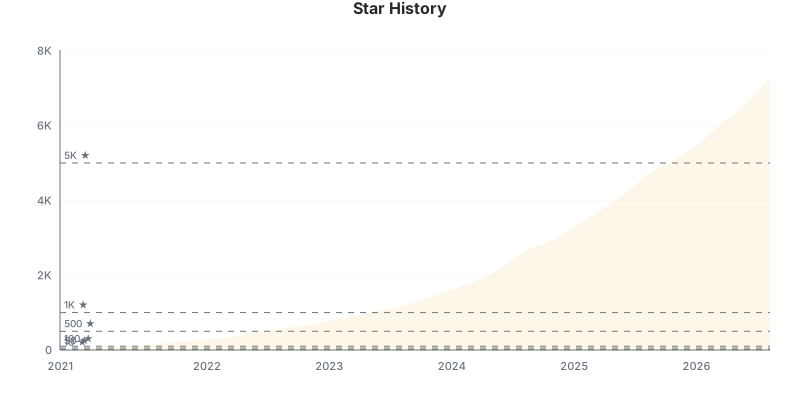
⭐️ Stargazers over time
⚖️ License
RapidOCR source code is copyright RapidOCR Authors and licensed under the Apache License, Version 2.0 (license = "Apache-2.0" in pyproject.toml and python/pyproject.toml). The license text is at apache.org/licenses/LICENSE-2.0.
The OCR model files are derived from official PaddleOCR models. Copyright in the upstream weights is held by Baidu and/or the respective PaddleOCR rights holders. Those upstream models are distributed under the Apache License, Version 2.0. RapidOCR does not claim ownership of the upstream weights.